
Text Size:
Images:
Colour:
Highlight:
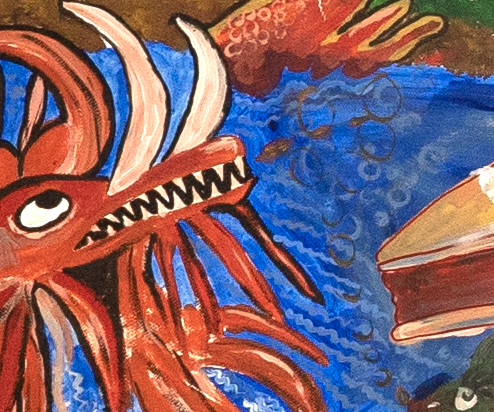
The Knucker
The Sussex Knucker limited edition print is available for sale in our shop. Click the link to buy!
The Bottomless Pool
Welcome back to Monument.
In this short episode I wanted to include a strange legend that has echoed down the ages, twisting and turning as it goes. Much like the antagonist in the story — a murky character from the distant past — the Knucker.
The Knucker lives in a bottomless pool, a type that seems unique to the southeast coast of England, along the spring line of the South Downs.
Here’s Chris Hare, local historian, to tell us more.
So what they have in common is that they all seem to be ponds fed by underground springs. I’m pretty sure they’re only found on the coastal plain — not in the Downs or the Weald. I stand to be corrected on that, but all the ones I know are along the coast.
The legend was that they never ran dry in the summer and they never froze in the winter. Always a constant temperature.
Now we hear Jacqueline Simpson, folklorist, who introduces the shady character of the Knucker.
My favourite mysterious location is the Knucker Hole, which used to be accessible, but now the owners have put a fence around it and you can’t get really close to it any longer.
It’s at Lyminster, a very small village near the sea end of the Arun valley. The village has a church, and just a few yards north of the church there is this pool which is said to be absolutely bottomless.
The story says that if you fell into it you’d come out in Australia — a well-known fact.
Its name is Knucker Hole, and the name itself is extremely fascinating because knucker and its variants are Old English words from before the Norman Conquest meaning water monster. You find it in Beowulf and other early English texts.
So since before the Norman Conquest that particular pond has been believed to contain a monster.
I’m delighted to say that the present minister of the church evidently likes the story, because he’s put a little stained glass window in the church showing one of the variants of the story — in which the Knucker gets got rid of.
Back to Chris with one story of how the Knucker was defeated, and how folktales continue to change and develop.
Another legend says that Jim Pulk, or Jim Puttock, killed the dragon by taking a great wagon with a huge poisoned pudding on it.
The Knucker came out and ate the horses and the wagon, and would have eaten Jim too. But he quickly got out of the way and cut the dragon’s head off.
But here’s an example of how folklore is created.
I gave a talk to the Sussex Archaeological Society in Shoreham about four years ago, when I was in the midst of researching The Secret Shore. I talked about the Knucker, and a woman in the audience said:
“I used to live in Lyminster, and in the 1960s divers went down into the Knucker Hole and found the remains of the wagon and the skeletons of the horses.”
I made a note of that.
Later during my research I came across a newspaper cutting from 1956 and another from 1970 when divers had indeed gone down into the Knucker Hole.
On one occasion the most exciting thing they found was a beer bottle.
On the other occasion — nothing.
So what had happened there, I think, was that the woman, as a child, had grown up with the story of the Knucker. She then remembered the divers going down, and over the years her imagination had merged the two things together so that she became convinced they’d found evidence of the legend.
But they didn’t.
I think we always want to believe in something a bit incredible — something special, something out of the ordinary. Given half the chance, most people will see it.
I think it’s about identity in place, and also about magic — or religion.
Perhaps we live in uncertain times. G. K. Chesterton said that when people stop believing in God they don’t believe in nothing — they believe in anything.
And today we have this whole diversity of belief systems.
I’ll leave the last words to Jacqueline, and her reason why the Knucker Hole is her favourite place.
The thought that the name goes back to Anglo-Saxon times — and proves that even then it was already a place surrounded by wonder — gives me great pleasure.
To think that more than a thousand years ago people were already marvelling at that pool.
You can find much more about the Knucker and other stories like it in Chris Hare’s book The Secret Shore, and in Jacqueline Simpson’s Folklore of Sussex. Links to these books are in the podcast description.
Please check out the website at monumentpodcast.com. There you can subscribe to Monument, listen to other episodes, and order a copy of the Monument Zine, which helps support the making of these podcasts.
The next episode will focus on Chanctonbury Ring — a place that is many things to many people: the fabled Sussex landmark, the Victorian picnic site, a place of dark power, inspiration for artists and writers, a pagan place of worship, and much more.
For now, thanks for listening.
Join our mailing list
We send occasional emails with news, events and creative opportunities.