
Text Size:
Images:
Colour:
Highlight:
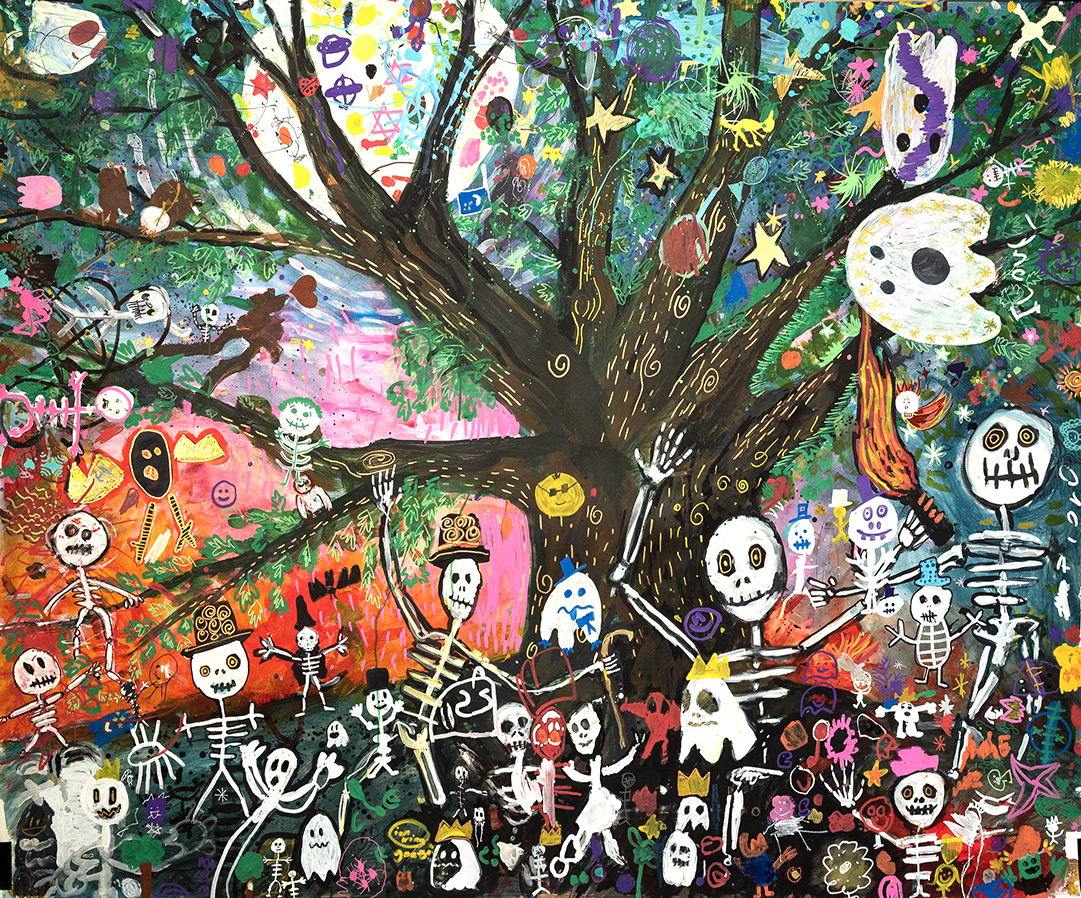
The Midsummer Tree – Episode 5, Monument Podcast
Welcome back to Monument. The next three episodes will feature people and places of Sussex. In this episode I’m starting with the Midsummer Oak Tree, standing on the edge of Worthing.
You’ll hear more news at the end of the podcast, but for now I hope you enjoy this episode. Thanks for listening.
On a small triangular patch of grass squeezed against a busy roundabout junction stands an old oak tree, hollow and squat, with its limbs lopped off. There’s a small plaque next to it identifying the tree as the host of an unusual story.
The story itself is strange enough, but there’s an interesting twist. In 2006 the Highways Agency was about to destroy the tree, having declared it unsafe and too close to the road.
The tree’s story saved it.
This episode explores the story of the Midsummer Tree and the people who have told it and retold it over time, rooting it into the earth like the old tree itself.
This tree, believed to be over 300 years old, was once rooted firmly in local folklore. Every year on Midsummer’s Eve it was believed that skeletons would rise up from the ground beneath it and dance around the tree, pulling up their own bones until daybreak.
Where do stories like this come from? What makes them endure?
To help explore this, I spoke with Jacqueline Simpson, researcher and author on folklore and legends. Jacqueline is an expert on folklore and lives just a couple of miles from the Midsummer Oak.
I guess you got interested in the tree on Broadwater Green, didn’t you?
That’s right.
The background is that the earliest study of Sussex folklore was written by Charlotte Latham in 1878. She recorded that there was a tree beside the path leading down from the Downs towards Worthing. It was an old tree, and skeletons were said to come out from under its roots and dance around it.
Charlotte Latham says the tree was beside a lane leading to Worthing, at the foot of the Downs. Now I would hardly call Broadwater Green the foot of the Downs, but the landscape has changed so much with development that it’s hard to argue over that detail.
Locally it has now been accepted that the tree at Broadwater is the tree Charlotte Latham meant, and therefore the centre of the story about skeletons rising and dancing around it on Midsummer’s Eve.
Apparently some people in Broadwater also call it the Hanging Tree, which might make sense if people were once hanged there. Their bones might then have been buried beneath the tree, which could have led to the idea of skeletons rising from the ground.
Whatever the truth of the matter, it’s now well accepted locally as a centre for folklore.
On Midsummer’s Eve people sometimes gather there to tell stories, sing folk songs, and dance around the tree.
I’ve been there myself. My dancing days are past, so I stand and watch.
I have a great respect for Charlotte Latham. She was a clergyman’s widow and collected folklore in a wonderfully practical way.
She recorded one anecdote I find absolutely charming. She was teaching a Sunday school class and explaining the idea of the devil as a spiritual enemy. The children got terribly excited and said they knew all about that. They knew about a man who had sold his soul to the devil.
Instead of dismissing their stories, she simply wrote them down and included them in her article.
I admire that practical approach. Many folklorists in the late nineteenth century were obsessed with theories. They were always trying to prove that something was prehistoric or a relic of some ancient religion.
Charlotte Latham simply recorded what people said.
Because of that, her work has endured.
I asked Jacqueline whether folklore stories were originally intended for children.
No — perhaps today they are told to children. But a couple of hundred years ago they were told to the whole community.
Stories serve different purposes. Some are warnings — “Don’t go near that pool,” for example. Others are religious warnings about people who broke rules such as fishing on a Sunday.
And some stories simply arise because certain places feel mysterious.
Stories make places important.
They give people a sense that this is our story, tied to this particular place.
And, of course, people enjoy stories that are gruesome, dramatic or funny. Folk imagination often leans towards the melodramatic.
I asked Jacqueline about the relationship between stories and places.
Stories can certainly change the way people see a place.
But how much does a place create a story, and how much does a story create a place?
I think often the place makes the story.
Take a standing stone in the middle of a field where there are no other stones. People naturally ask how it got there.
Perhaps a giant threw it. Perhaps the devil dropped it.
You wouldn’t attribute it to God, because God only makes useful things — and a stone in the middle of a field isn’t useful.
One of the great joys of studying folklore is that you don’t need to worry too much about facts. If someone said it somewhere at some point, that is enough for it to exist as folklore.
Archaeologists deal with provable facts.
Folklorists deal with stories.
At one time archaeologists never recorded stories told about a site. Now there is more recognition that these stories also form part of cultural heritage.
But how did Charlotte Latham’s story from 1878 reappear in 2006, when it helped save the tree from being cut down?
To answer that I spoke with Chris Hare, a local historian.
At the time I was working in Midhurst, driving past the tree every morning. One day I noticed it had been severely cut back.
I thought, that’s brutal — surely they’re about to remove it.
So I called the council and asked what was happening. They told me it was being prepared to be felled.
I said, “You can’t do that — that’s the Midsummer Tree.”
I explained the history and folklore behind it. Eventually they put me in touch with the Highways Agency.
Luckily I spoke to someone sympathetic. A series of calls and emails followed, and eventually we arranged a site meeting at the tree.
It was a foul February morning in 2006.
Everyone was engaged and wanted to find a solution. It was agreed the tree had to be cut back for safety reasons, but we argued about how much.
They wanted to reduce it to a stump. I argued that one of the lower branches could be kept.
In the end they agreed.
For a couple of years it looked like a stump with one branch. Then the foliage started growing back, and now it looks like a proper tree again.
They even installed a plaque explaining its story.
At that time Peter Wish, now head gardener at Highdown Gardens, was brought in to advise on conserving the tree.
That little patch of land contains several veteran oak trees. In fact the area once formed part of an old Norman estate, so some of the trees may be extremely old.
The Highways Agency engineers saw the hollow trunk and assumed the tree was unsafe.
But there are different ways of treating veteran trees. The quickest solution is simply to remove them. Conservation requires more careful management.
Once the tree’s folklore significance was recognised, its cultural value became clear.
So we agreed on a compromise: remove weight from the crown and allow the tree to regrow with a smaller canopy.
Interestingly, a hollow tree can actually be structurally strong. The cylindrical shape of the trunk remains stable, and the reduced weight makes it more flexible in strong winds.
In some ways the decay helps prolong the life of the tree.
The UK actually has more veteran trees than any other European country, largely because of how we have historically managed woodland.
People are increasingly recognising that ancient trees are part of our living heritage, just as much as historic buildings or monuments.
An oak tree may live for a thousand years: roughly 300 years growing up, 300 years in maturity, and 300 years gradually declining.
I like the idea of growing older and becoming hollow as a form of protection.
Returning to Chris Hare, there was still one question: how did we know this particular tree was the Midsummer Tree?
Chris explained that he first read about it in Jacqueline Simpson’s book Folklore of Sussex, which in turn referenced Charlotte Latham’s work West Sussex Superstitions, published in 1878.
Latham had recorded the story from local people, including one man who claimed to have seen the skeletons rise and dance around the tree at midnight.
But the precise location was later confirmed by Wilf Page, landlord of the Cricketers pub, whose family had lived in the area for generations.
He pointed to the oak at Broadwater and said, “That’s the tree.”
For Chris, that was good enough.
And now, ironically, the tree looks more mysterious than ever since it was cut back. It stands out from the surrounding trees and is instantly recognisable.
Folklore, after all, isn’t about factual certainty.
It’s about beliefs and stories.
If a story survives across generations, it becomes real in its own way.
The Midsummer Oak stands beside a busy road junction today. But many people still notice it and recognise its significance.
Old trees are clues to earlier landscapes. They outlive the buildings and roads around them.
Their roots connect us to the past.
Later I spoke to musician Chris Anderson, who visited the tree and composed a piano improvisation inspired by the legend of the dancing skeletons.
Places have a huge effect on music, he told me. Sometimes a piece of music becomes linked forever with a particular place where the idea first came to him.
Even an ordinary roundabout can become meaningful in memory.
Sometimes the most ordinary locations hold the most interesting stories.
In the end, perhaps every place has meaning if we choose to look for it.
Even the most mundane roadside junction can become a focus for memory, imagination, and story.
The Midsummer Oak is just a tree.
But once people begin to tell stories about it, it becomes something more.
Thanks to everyone who contributed to this episode: Chris Anderson, Chris Hare, Peter Wish, Jacqueline Simpson, and Adrian Rhodes.
The next episode will visit another Sussex landmark: Chanctonbury Ring, a hilltop site important to Celts, Romans, artists and writers, and many others through time.
If you enjoyed this episode please subscribe to the podcast.
You can also visit monumentpodcast.com to see an animation about the Midsummer Tree and find the first issue of the Monument Podcast Zine.
For now, thanks for listening.
Join our mailing list
We send occasional emails with news, events and creative opportunities.