
Text Size:
Images:
Colour:
Highlight:
Chanctonbury Ring
The Chanctonbury Ring painting is available to buy as a limited edition print! click on the link to take you to the Figment Arts shop
Up On Chanctonbury Ring – Episode 8, Monument Podcast
Chanctonbury Ring is a Sussex landmark. It’s on the edge of the South Downs Way, north of the seaside town of Worthing, and visible from great distances on all sides. Its iconic crown of beech trees forms part of its identity and its status as a landmark.
But those trees were laid low by the Great Storm of 1987.
The ring has endured nonetheless, having a character and quality that stretches back into the distant, forgotten past. The archaeological record defines Chanctonbury as a place of significance going back at least 2,500 years.
As well as its physical presence, Chanctonbury occupies a place in the imaginary landscape too, since the original beech trees were planted over 260 years ago. Poets, writers, musicians, artists, wizards, archaeologists, Morris dancers and occultists have all been drawn to the place.
This episode was an attempt to make a portrait of Chanctonbury. Every approach I made led me down a different path, so I’m just letting all the different voices speak for the hill, and you can find your own way through it.
Most of the recordings took place from April to June 2019, as the spring gave way to summer. I credit everyone properly at the end. But for now, join me as we make our way up onto Chanctonbury.
Me, my dad and my mum are here. And yeah… we’re exhausted. It was a very long walk, and the wind was so strong it could almost blow you off your feet.
We came up from the car park and walked all the way along the hill. Up and down. I got really, really tired. And then when we got to the top there were these few minutes where you were just fighting a losing battle with the wind.
Then we got into the forest and it was alright.
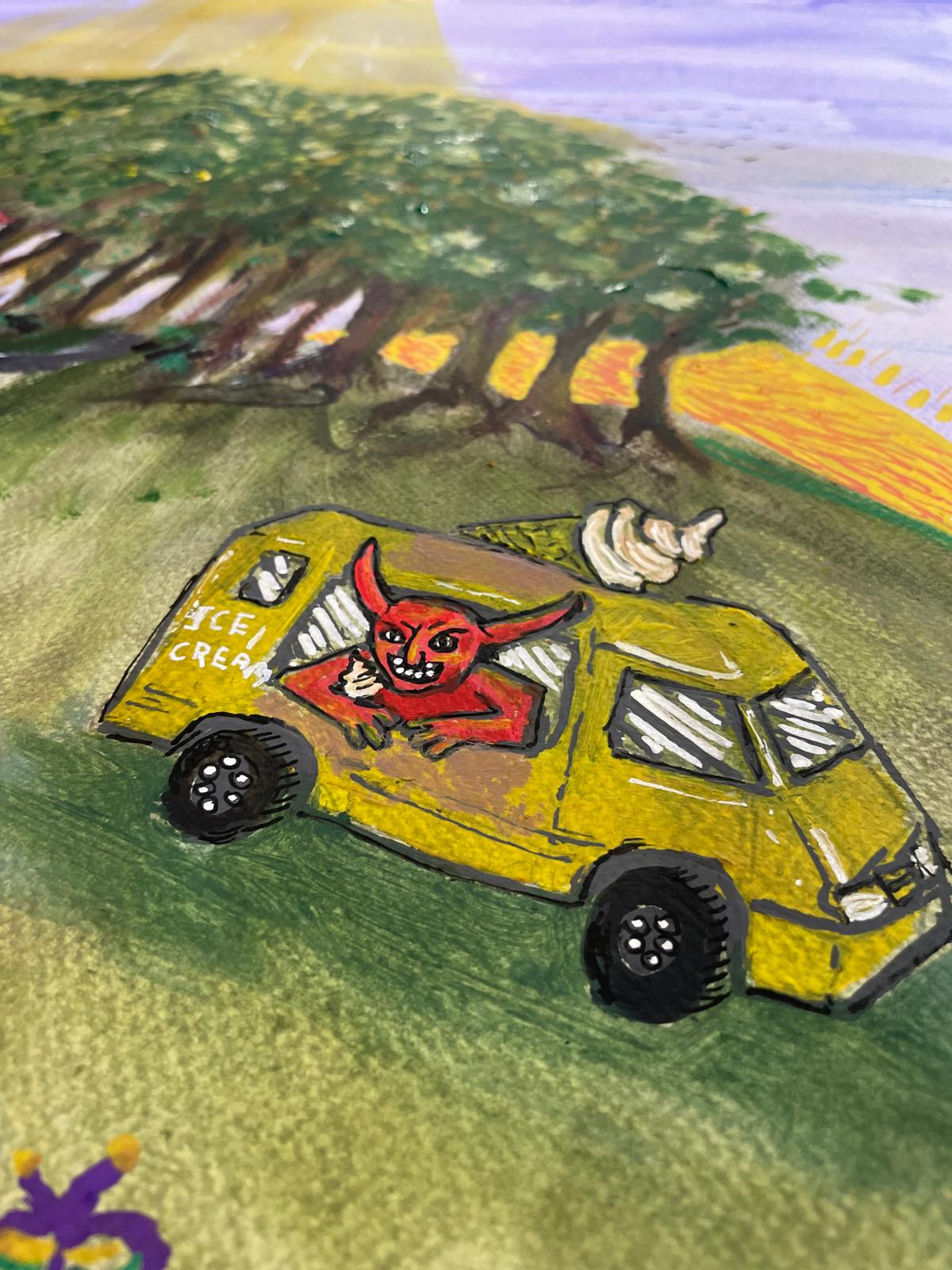
The legend says that if you walk anti-clockwise around the trees seven times, you’re going to summon the devil.
It’s a local legend that Chanctonbury Ring was created by the devil. And the devil can be summoned by running around the clump of trees seven times anti-clockwise.
When he appears, he will offer you a bowl of soup in exchange for your soul.
That’s one story.
Well, I think I’m in a little bowl of soup for you. That’s a pretty big demand if you ask me. I mean, you’d think the devil would at least play fairly with his games.
He couldn’t have made it easier to reach or something? Maybe a staircase. That would have been nice.
I think there are some stories that say he also grants you a wish.
Oh, I like a wish.
In exchange for your soul.
No thank you.
It was a sort of turning point in my study of folklore. I’d studied Scandinavian folklore.
One day, in 1968, I had some work being done in the house here, and the workmen were talking about what the countryside used to be like. They mentioned Chanctonbury to me.
One of them said, “How about when you’re roaming around and the devil comes out and gives you a bowl of soup?”
And the other said, “No, you’ve got it wrong. What he gives you is a cup of milk.”
They started discussing it, and I thought — here am I carefully studying Icelandic stories, and there are some right here near me.
I remember thinking that would be enough for a little article. And that article eventually became a book.
I think the theory we have is interesting. When you look at the sorts of stories that become associated with places — whether people meant them as true or not — they’re good stories.
That’s what we do with places.
It’s what we do with our own lives as well. Whether we’re telling the truth or creating something that’s interesting.
Certain places just seem to generate more interesting stories.
If a place becomes associated with magical stories, then people are going to come to the place expecting a sensation — expecting something magical.
Then they experience something, and they tell more stories.
Chanctonbury is an interesting one. There’s been a lot of activity there. Human remains have been found there. Lots of stories have grown up about it.
I’ve stood there before, looking out to the east when no one’s around, and you feel like you’re being watched. Like someone’s watching you from the trees.
There’s something about being on top of the downs with tree cover. It’s a very unique little environment.
It can be very windy and blustery, or totally silent and still. But you’re right on the top of these hills.
The origins of these hillforts are interesting. If you just try to understand them in terms of defence as forts, you’re not going to get very far.
It’s more about statements in the landscape. It’s about enclosing and protecting things at certain times.
But people aren’t living there. There’s no evidence of huts.
So it might be places to bring people together. Or bring game. It might be places for gatherings or seasonal events.
The thing about these places is the statement they make in the landscape.
You’ve got this incredible view.
But also that entire view catchment is looking at this hill.
Archaeologically the site is multifaceted.
There’s evidence of Neolithic stone working. In the Bronze Age there were numerous burial mounds built across the area, around 2000 BC.
One burial mound excavated on the west flank of the hill contained a female burial with a Wessex-style bronze dagger.
Later in the Bronze Age cross dykes were built across the hill, marking out a special area. Inside that area there are many burial mounds.
Then the enclosure on the top of the hill was built in the early Iron Age, around 600–700 BC.
But interestingly, it probably wasn’t a defensive hillfort. There’s no water supply there, and the banks and ditches aren’t substantial enough.
There have been pits found with human remains and pottery, so it may have had some kind of religious function.
Later, in the Roman period, temples were built on the hill.
The first was a classic Romano-British square temple. Then a second temple was built nearby with a polygonal design.
We don’t know exactly what was happening there, but the temples contained lots of pig bones, and the area has produced small pig figurines.
So archaeologists sometimes refer jokingly to a “Sussex pig cult.”
Chanctonbury means many things to many people.
It’s been used, forgotten, rediscovered, defended, loved, feared and revered longer than we know.
I can’t quite quantify what it is about the place, but certainly the wind in the trees seems to play a large part in defining the character of the hill and the ring itself.
I went up to the ring on the morning of the 1st of May with the Chanctonbury Morris Men to celebrate the start of summer and see another side of the hill.
Traditionally Morris sides dance at dawn on May Day to welcome in the summer.
Morris dancing almost disappeared after the First World War. Entire village groups of dancers were wiped out in the Pals battalions.
In many places women kept the folk dance traditions alive until Morris sides gradually formed again in the twentieth century.
Today Morris dancing is a living tradition. It adapts over time. People do it for fun and community.
Many people come up to the ring every May Day morning to watch the dancing.
It’s a good way to start the summer.
The hill has also seen activity in more recent history. During the Second World War the surrounding area was bombed, and even today farmers occasionally uncover unexploded bombs when ploughing fields.
One May morning I walked up from the village before dawn.
A thin layer of mist covered everything — spider webs, grass, bottles left from the night before.
Birds rose from the fields as the sun began to glow.
In the distance I could see Chanctonbury Ring, seeming to levitate between earth and sky.
Once it had been crowned by a dense circle of beech trees — an island at the top of the open downs.
Now the circle is broken.
But if I squint, I can still see them.
The ghost trees.
I approached the ring and found sheep clustered within it, their lambs gathered among the trees.
The mist outlined the ancient hillfort.
Tufts of wool caught on the branches like dreamcatchers.
Each one a memory of spring.
And I love that feeling when you leave a hill and it seems to urge you onward.
As if it knows you’re done.
Join our mailing list
We send occasional emails with news, events and creative opportunities.