
Text Size:
Images:
Colour:
Highlight:
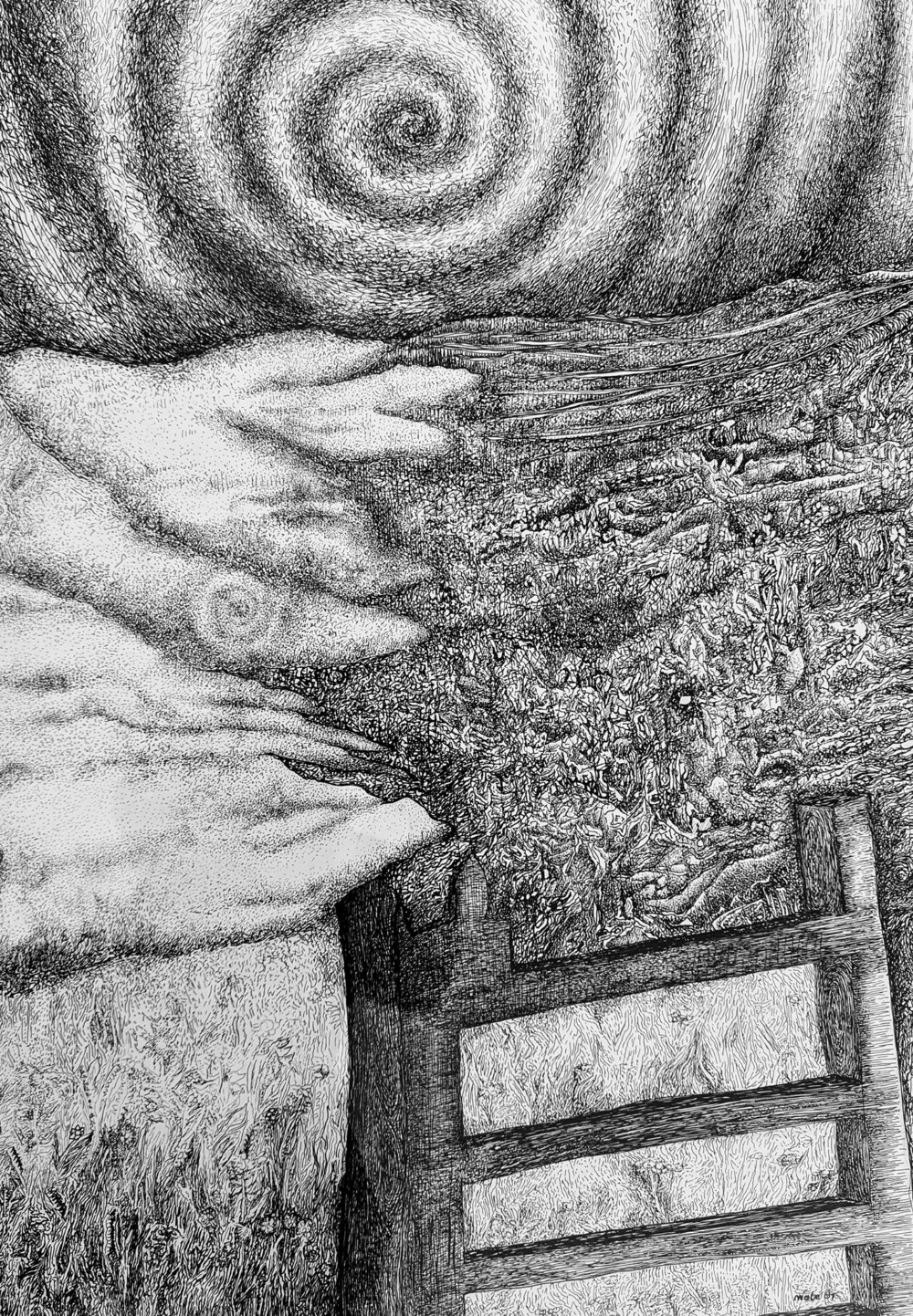
Colin Hambrook | Mount Caburn I and II | Rotring pen on 300gsm archive paper
Drawing is both a grounding and expressive practice for me. It helps me focus and release nervous energy through repetitive mark-making — a process not unlike stimming. Living with complex PTSD, my memory is often fragmented. Drawing and writing allow me to reconnect with myself. The act of writing in response to the drawings helps me uncover stories hidden within the marks.
My drawings begin as quick, intuitive sketches made in the landscape. These initial impressions are later developed through layered mark-making. The result is dense, textured surfaces that read as psychological landscapes or inner maps.
The two drawings shown here were A4 drawings were created near a series of barrows known as the Devil’s Book in a valley below the Iron Age hill fort, Mount Caburn. The initial drawings of scenes in the valley were then scaled up to A1 size in the studio. The valley holds a unique stillness — a profound silence that feels timeless. Its slopes are etched with traces of human activity going back nearly 5,000 years. This connection to deep time and human presence informs the emotional and material layers of the artworks.
In the process of drawing, I often lose myself in the act of patterning. Textures evolve into imagined worlds, where light shifts across the page and figures or creatures seem to emerge. The presence of orbs in these works hint at ancient energies or unseen inhabitants of the land. The spiral — a recurring motif — speaks to natural cycles of movement and growth.
I often feel that the marks I make hold ancestral memory. There is something encoded in the lines — a sense of story held within the DNA. As such these drawings reflect a quiet act of connection: with the land, with the past, and with the self. At its core, this work is about presence. It’s about stepping out of ego, surrendering the idea of who we think we are, and entering a state of deep listening — to the earth, to the body, and to the moment.
Sussex, the last of Britain’s Anglo-Saxon kingdoms to convert to Christianity did so around the 680s. Although the Vikings never directly ruled Sussex legends attached to the land are clearly influenced by the Danes. On the slopes of Mount Caburn, not far from Glynde is a barrow known as Gill’s grave. Gillingr was a downland giant who threw his hammer from the top of the hill. He was the father of Suttungr, a prominent figure in the saga of the mead of poetry. Gillingr is known for being murdered by the dwarves Fjalar and Galar, an act that led to Suttungr’s revenge and his possession of the sacred drink of the gods.
Gill the Giant (or: How I Lost My Poet’s Mead and My Dignity)
I’m Gill the giant — jotunn, see?
A Sussex lad with Norse degree.
You think we gods gave Sussex a miss?
No, mate — I owned these hills of bliss.
I stomped through Caburn, bold and brash,
My hammer flew with every crash.
I wasn’t nice. I caused a scene —
A nuisance, loud, and slightly mean.
Before the Christians crashed the gig,
We had our myths, both small and big.
They showed up shouting “Sin!” and “Shame!”
And blamed the devil. We got the blame.
They said, “A goat-footed fiend, how rude!”
That’s just my cousin, slightly lewd.
Then came their saints with robes and scowls —
They chased us off with hymns and howls.
My grave once lay neath Caburn’s rise —
A modest plot beneath the skies.
Dr. Shrapnell came one day
And dug my resting bones away.
He dug me up in 1804,
Then shrugged and left me — what a bore.
Now Glynde Station’s where I lay,
With zero plaque. Just trains. All day.
But once I played a mighty part
In tales that stir the Norseman’s heart.
I featured in a saga grand
Of the poet’s mead and sleight of hand.
The gods had fought and made a man
From sacred spit (don’t ask the plan).
Kvasir, wise, shared knowledge wide,
Enlightening minds with great pride.
Two dwarves drained his blood, they brewed a brew
That turned dull minds to bards who knew.
They called me up: “Come take a sip!”
I thought, “Nice brand deal! Sponsorship!”
But no — they dragged me out to sea,
And tipped the boat to murder me.
I sank with dignity and flair —
A soggy myth with seaweed hair.
My son Suttungr, none too sweet,
Found those two dwarfs, turned the heat.
He marooned them on a reef to drown
Till they gave the mead to calm him down.
He took it home with great delight,
And left it guarded day and night.
His daughter Gunnlöd kept it tight,
Inside a cave with zero light.
Enter Odin: crafty chap,
Who smelled that mead like dwarven sap.
He met my other son, named Baugi,
(Who wore a tunic, somewhat saggie).
Odin said, “I’ll do your chores,
Just let me sip what’s yours-not-yours.”
He mowed and ploughed and stacked the hay,
Then asked for mead — no luck that day.
When work was done, he drilled a hole,
And slid right in — his sneaky goal.
He wooed fair Gunnlöd, smooth and sly,
Then drank the mead and said goodbye.
He turned into an eagle grand,
And flapped back home with booze in hand.
But Suttungr followed, wing to wing —
A proper high-speed feathery fling!
The gods set jars to catch the gold,
But Odin dropped some (truth be told).
It leaked out from his rear in fear —
That’s what bad poets now drink, dear.
The rest? It went to those above,
And mortals blessed with gift and love.
So if you hear a thunder roll,
That’s just me stomping, on patrol.
Join our mailing list
We send occasional emails with news, events and creative opportunities.